Symptom
|
|
Possible cause
|

Healthy leaf (left) vs. diseased leaf with distinctive mottled yellowing (right) (© Dagmar Hanold and John Randles, Waite Agricultural Research Institute)
|
|
Cadang-cadang (CCCVd)
|

Sooty mould growth from honeydew secretions, surrounding woolly insect colonies at the base of a frond (© Lyle J. Buss, University of Florida)
|
|
Cocoa mealybug
Pineapple mealybug
Striped mealybug
Coconut mealybug
|
|

Sooty mould growth from surrounding woolly insect colonies and honeydew secretions (© Lyle J. Buss, University of Florida)
|
|
Cocoa mealybug
Pineapple mealybug
Striped mealybug
Coconut mealybug
|
|
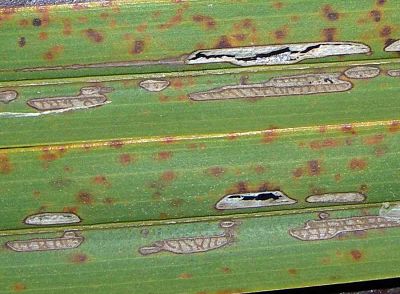
Caterpillar feeding resulting in light grey lines or "windows" with exposed leaf skeleton (© PestNet)
|
|
Coconut flat moth
Additional symptoms of coconut flat moth include:
- Leaves that have separated away from the midrib.
- Damage to middle aged leaves that has progressed to older leaves.
- Unhealthy and dry leaves.
- Death of damaged palms.
- Possible nut reduction in mature palms and reduced seedling growth.
|
|
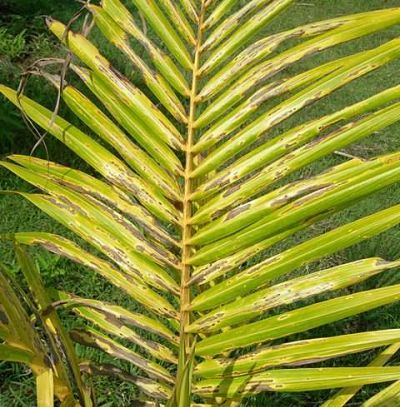
Leaflets showing brown, burnt looking decay (© PestNet)
|
|
Coconut hispine beetle
Additional symptoms of coconut hispine beetle include:
- Red-brown narrow strips of feeding damage on the unopened spear leaf, parallel to the midrib.
- Enlarged strips or streaks when the leaf unfolds that look blotchy and grey-brown.
- Malayan Dwarf varieties are showing severe symptoms compared to others.
|
|

Brown narrow furrows along leaves. Adult beetles may be seen feeding and leaving the furrows behind (© Jean-Pierre Labouisse, CIRAD)
|
|
Coconut leaf miner
Additional symptoms of coconut leaf miner include:
- Damage to the three to four youngest leaves first.
- Mines from the base of the leaf, parallel to the midrib.
- Feeding damage that has a burnt or decayed appearance.
- Decayed and weak leaflets, eventually curling over and dying.
- Weakened fronds may appear ragged due to tearing and breaking in the wind.
- In severe cases, palms within one plantation may all turn brown.
- Early nut fall and reduced flower production.
- Symptoms appearing after droughts.
|
|

Damage on leaves that is brown to grey and appears burnt or decayed (© Jean-Pierre Labouisse, CIRAD)
|
|
Coconut leaf miner
Additional symptoms of coconut leaf miner include:
- Damage to the three to four youngest leaves first.
- Narrow furrows along a third to half of the leaflet from the tip.
- Mines from the base of the leaf, parallel to the midrib.
- Decayed and weak leaflets, eventually curling over and dying.
- Weakened fronds may appear ragged due to tearing and breaking in the wind.
- In severe cases, palms within one plantation may all turn brown.
- Early nut fall and reduced flower production.
- Symptoms appearing after droughts.
|
|

Bored holes at the base of the fronds (© Pacific Biosecurity)
|
|
Coconut rhinoceros beetle - Oryctes rhinoceros
Additional symptoms of coconut rhinoceros beetle include:
- Boring in young fronds that are yet to open.
- V or wedge shaped sections of the leaf missing.
- Excreted plant tissue and frass at the entrance of bored holes.
- Palms of a young age of 1-3 years more severely affected.
- Healthy palms older than 1-3 years, mature and tall (20-30 m), flower or fruit bearing, may have reduced strength and growth of the crown.
- Secondary infections visible at the bored holes.
|
|

V shaped feeding damage on fronds (© Pacific Biosecurity)
|
|
Coconut rhinoceros beetle - Oryctes rhinoceros
Additional symptoms of coconut rhinoceros beetle include:
- Boring in young fronds that are yet to open.
- Bored holes in the base of the frond midrib (10-50 cm from the base).
- Excreted plant tissue and frass at the entrance of bored holes.
- Palms of a young age of 1-3 years more severely affected.
- Healthy palms older than 1-3 years, mature and tall (20-30 m), flower or fruit bearing, may have reduced strength and growth of the crown.
- Secondary infections visible at the bored holes.
|
|
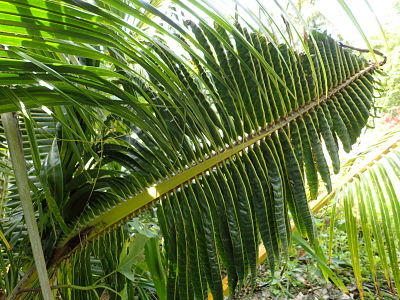
Palm frond leaflets look squeezed and crushed together while the fronds show twisting, nicks and truncation (© Department of Agriculture and Water Resources, Australia)
|
|
Melanesian coconut rhinoceros beetle
Additional symptoms of Melanesian coconut rhinoceros beetle include:
- Bored holes into the frond growing point with excreted material.
- Fronds with wedge or V-shaped patterns.
- Fruit may have exit damage from the beetle.
- Young palms up to 5 years old showing more damage.
- Bored holes may have other pest insects (termites and weevils) inside.
|
|

Yellow spots concentrated on an area of a leaf. Note the brown spots starting to appear (© TNAU)
|
|
Coconut scale |
|

A leaf with a crusted surface. A closer look may show a heavy yellow-orange scale insect colony (© TNAU)
|
|
Coconut scale |
|

Leaf tissues looking yellowed or brown and wilted, especially near the tip of the frond (© Merle Shepard and Gerald Carner, Clemson University)
|
|
Coconut scale |
|

Yellowing and following death of leaflets from the tip of the diseased frond (© Geoff Gurr, Charles Sturt University)
|
|
Finschhafen disorder |
|

Malayan Dwarf variety showing red-greyish brown leaves throughout green healthy leaves (© Nigel A. Harrison, University of Florida)
|
|
Lethal yellowing
Additional symptoms of lethal yellowing include:
- Blackening and rotting of the inflorescences (flower clusters).
- Fronds die and hang down.
- Death of the emerging spear leaf.
- Death of the growing point of the palm occurs next.
- The crown falls, leaving a dead trunk only, sticking up like a telegraph pole.
|
|

Yellow splotches on leaves that may have turned brown and yellowing of the midrib (© Jorge Peña, University of Florida)
|
|
Red palm mite |
|
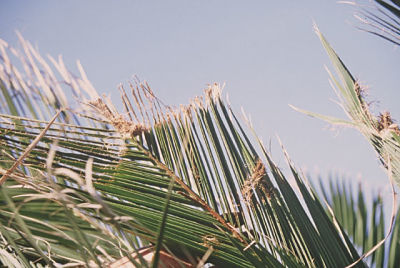
Straight edged of leaves rather than pointed tips (© International Palm Society)
|
|
Palm weevil
Additional symptoms of palm weevil include:
- Chewed holes or tunnelling with ejected material and possibly brown liquid at the entrance on frond bases and stem.
- Crunching and chewing sounds when in close range to the trunk.
- Hollowed out palm trunk.
- Wilted crown.
- Death of fronds.
- Eventual collapse of palm.
|